ExaSheds: Advancing Watershed System Science using Machine Learning-Assisted Simulation
Summary
This image shows the location of Neversink Watershed within the Delaware River Basin.
ExaSheds is a DOE funded project that aims to advance watershed system science using machine learning-assisted simulation.
The USU team was awarded a subcontract to develop integrated watershed hydro-thermal models for the Upper Neversink Watershed within the Delaware River Basin using the Advanced Terrestrial Simulator. The developed watershed models will provide training data for ML-assisted inverse modeling which will be performed by the PNNL team.
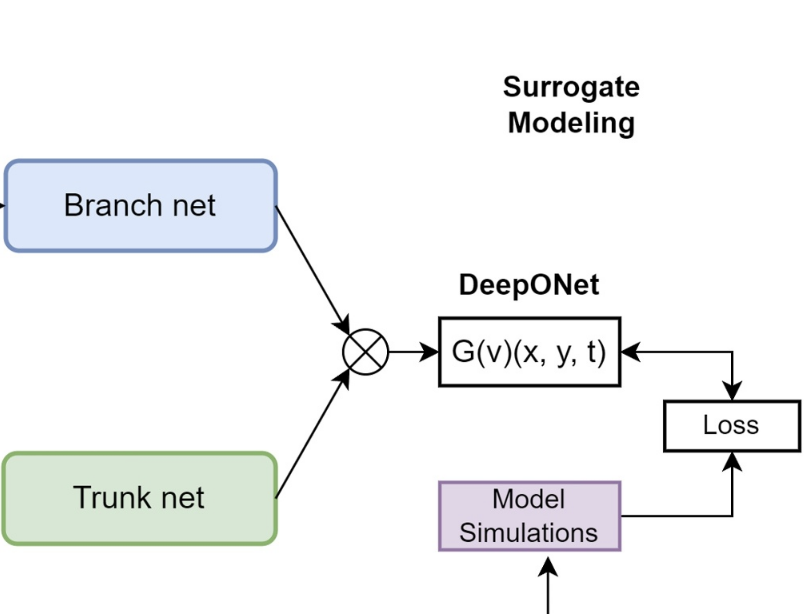
10/01/2024: New publication out led by Dr. Alex Sun on the development of a deep neural operator learning approach for the parameter estimation in the Neversink Watershed (Sun et al., 2024).
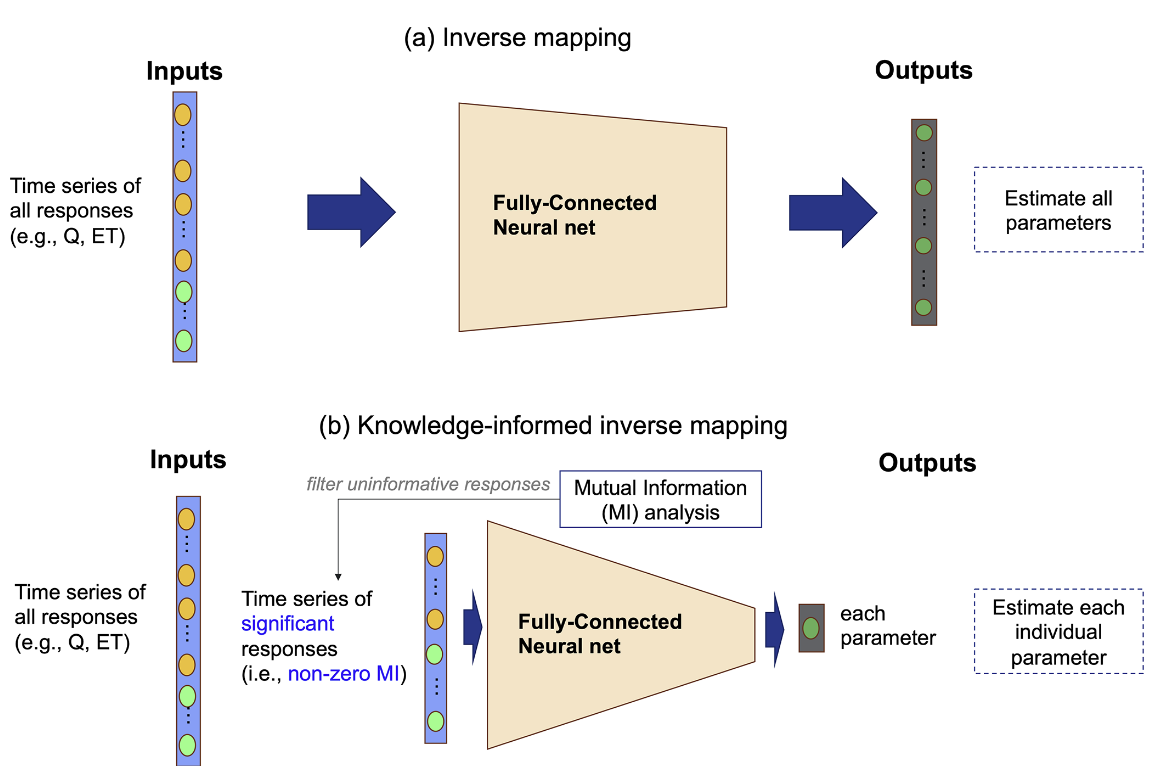
09/01/2024: New publication out led by Dr. Jiang on the development of a knowledge-informed deep learning technique for parameter estimation in the Neversink Watershed (Jiang et al., 2024).
07/01/2023: New paper out led by Dr. Jiang on using knowledge-informed deep learning for hydrological model calibration in the Coal Creek Watershed in Colorado (Jiang et al., 2023).
Publications
2024
WRR
Bridging Hydrological Ensemble Simulation and Learning Using Deep Neural Operators
Alexander Y. Sun, Peishi Jiang, Pin Shuai, and 1 more author
Ensemble-based simulation and learning (ESnL) has long been used in hydrology for parameter inference, but computational demands of process-based ESnL can be quite high. To address this issue, we propose a deep neural operator learning approach. Neural operators are generic machine learning algorithms that can learn functional mappings between infinite-dimensional spaces, providing a highly flexible tool for scientific machine learning. Our approach is built upon DeepONet, a specific deep neural operator, and is designed to address several common problems in hydrology, namely, model parameter estimation, prediction at ungaged locations, and uncertainty quantification. Here we demonstrate the effectiveness of our DeepONet-based workflow using an existing large model ensemble created for an eastern U.S. watershed that is instrumented with 10 streamflow gages. Results suggest DeepONet achieves high efficiency in learning an ML surrogate model from the model ensemble, with the modified Kling-Gupta Efficiency exceeding 0.9 on holdout test sets. Parameter inference, carried out using the trained DeepONet surrogate model and genetic algorithm, also yields robust results. Additionally, we formulate and train a separate DeepONet model for physics-informed, seq-to-seq streamflow forecasting, which further reduces biases in the pre-trained DeepONet surrogate model. While this study focuses primarily on a single watershed, our approach is general and may be extended to enable learning from model ensembles across multiple basins or models. Thus, this research represents a significant contribution to the application of hybrid machine learning in hydrology.
JoH
Optimizing Parameter Learning and Calibration in an Integrated Hydrological Model: Impact of Observation Length and Information
Peishi Jiang, Pin Shuai, Alexander Y. Sun, and 1 more author
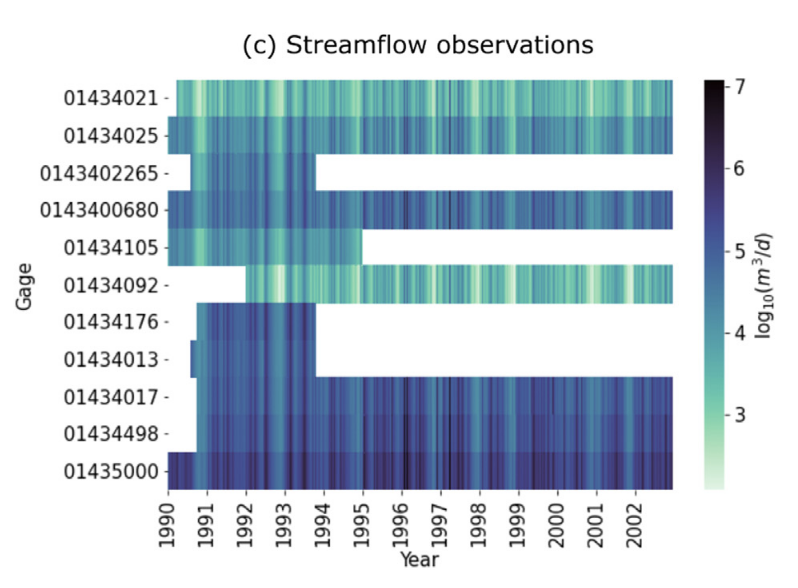
Integrated hydrological modeling is gaining popularity due to its mechanistic representation of the surface and subsurface processes. However, estimating the parameters of such process-based models can be computationally expensive if careful consideration is not given to the length of streamflow observations used during model calibration. Here we evaluate the influence of the calibration period, the role of streamflow information content, and the gage location in parameter learning and calibration of a fully integrated hydrological model, the Advanced Terrestrial Simulator (ATS). We conducted the study at the Upper Neversink River Watershed within the Delaware River Basin, where streamflow observations are available at 11 gages with varying record lengths. We leveraged a recently proposed knowledge-informed deep learning technique for parameter estimation. To assess the impact of observation period and gage location, model parameters were learned on scenarios using different chunks of streamflow observations, including (1) using only one year or consecutive multiple years of streamflow observations at the watershed outlet and (2) using one shared year of observations at each of the sub-catchment gages, with the period from 1991-10-01 through 1999-09-30 as the overall calibration period. Using the estimated parameters, ATS was rerun for each scenario and evaluated on a subsequent period from 1999-10-01 through 2002-09-30. Results show that the basin outlet discharge prediction is mostly improved when using at least four years of observations for parameter estimation. Further, the performance of the calibrated ATS run correlates with the information content of the observed streamflows, suggesting that the information-theoretic metrics could be indicators for selecting the observation period for parameter estimation. Finally, we find that observations from an informative gage can be used in learning parameters to predict the streamflow at a nearby gage, which would potentially lower the computational expense by reducing the watershed domain used in calibration. Our success underscores the potential of using information theory to achieve robust model parameter estimation on a reduced computational budget.
2023
HESS
Knowledge-informed deep learning for hydrological model calibration: an application to Coal Creek Watershed in Colorado
Peishi Jiang, Pin Shuai, Alexander Sun, and 2 more authors
Deep learning (DL)-assisted inverse mapping has shown promise in hydrological model calibration by directly estimating parameters from observations. However, the increasing computational demand for running the state-of-the-art hydrological model limits sufficient ensemble runs for its calibration. In this work, we present a novel knowledge-informed deep learning method that can efficiently conduct the calibration using a few hundred realizations. The method involves two steps. First, we determine decisive model parameters from a complete parameter set based on the mutual information (MI) between model responses and each parameter computed by a limited number of realizations (∼50). Second, we perform more ensemble runs (e.g., several hundred) to generate the training sets for the inverse mapping, which selects informative model responses for estimating each parameter using MI-based parameter sensitivity. We applied this new DL-based method to calibrate a process-based integrated hydrological model, the Advanced Terrestrial Simulator (ATS), at Coal Creek Watershed, CO. The calibration is performed against observed stream discharge (Q) and remotely sensed evapotranspiration (ET) from the water year 2017 to 2019. Preliminary MI analysis on 50 realizations resulted in a down-selection of 7 out of 14 ATS model parameters. Then, we performed a complete MI analysis on 396 realizations and constructed the inverse mapping from informative responses to each of the selected parameters using a deep neural network. Compared with calibration using observations covering all time steps, the new inverse mapping improves parameter estimations, thus enhancing the performance of ATS forward model runs. The Nash–Sutcliffe efficiency (NSE) of streamflow predictions increases from 0.53 to 0.8 when calibrating against Q alone. Using ET observations, on the other hand, does not show much improvement on the performance of ATS modeling mainly due to both the uncertainty of the remotely sensed product and the insufficient coverage of the model ET ensemble in capturing the observation. By using observed Q only, we further performed a multiyear analysis and show that Q is best simulated (NSE > 0.8) by including in the calibration the dry-year flow dynamics that show more sensitivity to subsurface characteristics than the other wet years. Moreover, when continuing the forward runs till the end of 2021, the calibrated models show similar simulation performances during this evaluation period as the calibration period, demonstrating the ability of the estimated parameters in capturing climate sensitivity. Our success highlights the importance of leveraging data-driven knowledge in DL-assisted hydrological model calibration.